Your guide to the new North American cargo securement standard
How many tiedowns you need, and how to tell when your chain, binder or webbing is no longer fit to use.
Minimum number of tiedowns
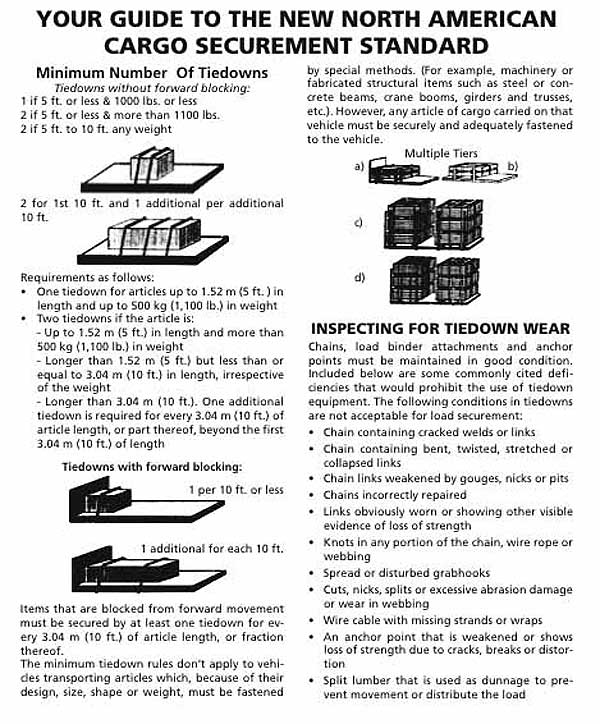
Without forward blocking
| Article length and weight | Tiedowns |
|---|---|
| 5 ft or less and 1000 lbs or less | 1 |
| 5 ft or less and more than 1100 lbs | 2 |
| 5 ft to 10 ft, any weight | 2 |
| Longer than 10 ft | 2 for the first 10 ft, plus 1 for each additional 10 ft |
Requirements as follows: one tiedown for articles up to 1.52 m (5 ft) in length and up to 500 kg (1,100 lb) in weight.
Two tiedowns if the article is up to 1.52 m (5 ft) in length and more than 500 kg (1,100 lb) in weight, or longer than 1.52 m (5 ft) but less than or equal to 3.04 m (10 ft) in length, irrespective of the weight.
If the article is longer than 3.04 m (10 ft), one additional tiedown is required for every 3.04 m (10 ft) of article length, or part thereof, beyond the first 3.04 m (10 ft) of length.
With forward blocking
| Article length | Tiedowns |
|---|---|
| 10 ft or less | 1 |
| Each additional 10 ft | 1 additional |
Items that are blocked from forward movement must be secured by at least one tiedown for every 3.04 m (10 ft) of article length, or fraction thereof.
The minimum tiedown rules don't apply to vehicles transporting articles which, because of their design, size, shape or weight, must be fastened by special methods (for example, machinery or fabricated structural items such as steel or concrete beams, crane booms, girders and trusses). However, any article of cargo carried on that vehicle must be securely and adequately fastened to the vehicle.
Inspecting for tiedown wear
Chains, load binder attachments and anchor points must be maintained in good condition. Included below are some commonly cited deficiencies that would prohibit the use of tiedown equipment. The following conditions in tiedowns are not acceptable for load securement:
- Chain containing cracked welds or links
- Chain containing bent, twisted, stretched or collapsed links
- Chain links weakened by gouges, nicks or pits
- Chains incorrectly repaired
- Links obviously worn or showing other visible evidence of loss of strength
- Knots in any portion of the chain, wire rope or webbing
- Spread or disturbed grabhooks
- Cuts, nicks, splits or excessive abrasion damage or wear in webbing
- Wire cable with missing strands or wraps
- An anchor point that is weakened or shows loss of strength due to cracks, breaks or distortion
- Split lumber that is used as dunnage to prevent movement or that distributes the load
See the original printed guide, with diagrams
This guide is carried over from our previous website. Check it against the current standard before you rely on it for a load. Need cargo control gear? See trailer parts and towing.